
Before this session, 96 people answered a simple question: What's your biggest challenge right now? The top answer wasn't about getting access to AI — it was about getting people to actually use AI well, day to day.
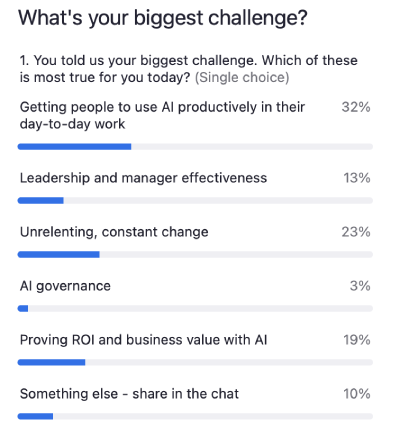 During the live event, we polled the room and heard it again: Nearly a third of attendees named "getting people to use AI productively in their day-to-day work" as their single biggest challenge today.
That's not an adoption problem. It's an impact problem — and it's exactly what Impact Lab was built to address, as explained in this replay of our session with Jim Perry, co-founder of Harness Intelligence, and Peg Ruppert, partner at Advantage Performance Group.
The difference between using AI and using it like an Impact Player is the difference between working faster and working on what actually matters.
More from the session:
-
Read about the research
Richard Hodge's piece on why Impact Players — Liz Wiseman's highest performers — may see 4-5x the impact or more with AI.
-
Get The AI-Enabled Impact Player infographic
A practical breakdown of Liz Wiseman's 5 practices, and exactly how AI multiplies each one.
- Learn more about Impact Lab
Download a one-page overview - Send us your feedback: We'd love to hear from you! Answer a few short questions here!
If you're thinking about how to move your organization from simply using AI to using AI with high impact, talk to your Advantage partner or contact us — we'd love to talk through what that looks like for you.

About our presenters
Advantage Partner Peg Ruppert is a longtime master of all things Multipliers and actively working with clients now across the Multipliers continuum (including Impact Players) to drive real business results.
Jim Perry's perspective is firsthand. While at BTS, he co-developed the Multipliers Simulation with Liz. Today, as co-founder of Harness Intelligence along with Richard Hodge, Jim continues collaborating with Liz and The Wiseman Group to help organizations apply the principles behind Impact Players and Multipliers to AI adoption and organizational change.